
Diving deep into House Bills 5980 and 5981
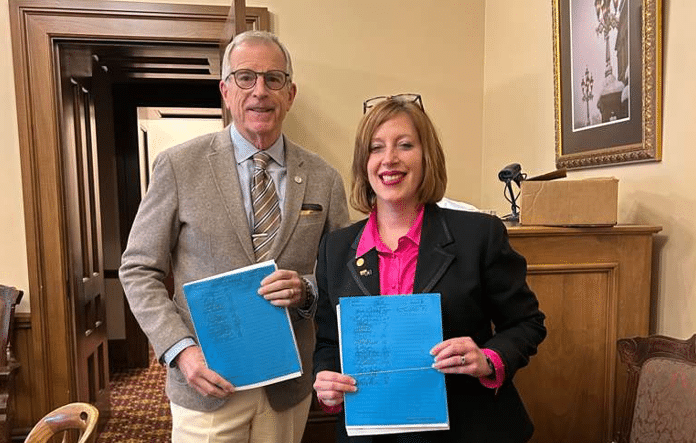
Rep. Mark Tisdel and Rep. Julie Rogers (photo courtesy of housedems.com)
On May 14th, House Bills 5980 and 5981 were introduced with bi-partisan support led by Representative Mark Tisdel (R-Rochester Hills) and Julie Rogers (D-Kalamazoo). You can read MBIPC’s press release on the introduction here.
These bills are the latest attempt by legislators who understand the urgency of a narrow solution to ensure people catastrophically injured in a car crash have access to quality rehabilitation and expert long-term care. In this issue of Diving Deeper, we will examine what is in the bills, why the policy is needed, and what is different with this legislation compared to previous attempts.
What’s In the Bill and Why It is Needed
Reimbursement Rates for Community-Based Residential Programs:
What is Included: HB 5980 establishes reasonable reimbursement rates at three distinct and defined levels of care. The rates are rooted in the state’s Medicaid Brain Injury Services reimbursement for residential care, with Level 2 of the proposed legislation being 100% of the state’s reimbursement level. The rates for Level 1 (80% of the state's reimbursement) and Level 3 (150% of the state’s reimbursement) represent the different levels of care that do not exist within the state’s Medicaid plan.
Why It is Needed: Currently residential programs are subject to the fee cap that limits their reimbursement rates at 52.5% of their 2019 charge master plus inflation (roughly 13% annual accumulation since July 1, 2022). That level of reimbursement is far below the cost of care and severely limits a program’s ability to accept patients injured after 2019, especially patients with higher needs, requiring more resources.
People with catastrophic injuries such as brain and spinal cord injury do not belong in a nursing home or they may not be safe to live at home. They do not have the specialized training and are not held to the appropriate quality standards that an accredited community-based residential program must meet. Furthermore, they lack the appropriate ratios to properly supervise and care for people with brain injuries that may have severe cognitive, behavioral, mental, and/or physical impairments. Residential programs are the safest, most cost-effective, and community inclusive option for people with severe injuries that cannot live at home.
People purchasing lifetime benefits are paying for this level of long-term care should they ever need it. The only way to ensure they can access these services is through a legislative solution that provides a reasonable level of reimbursement, as those found in HB 5980.
Removal of Reimbursement Cap Tied to a Provider’s 2019 Charge
What is Included: HB 5980 removes the unfair reimbursement cap for companies which limits their reimbursement to their 2019 charges, plus annual inflation determined by the Department of Insurance and Financial Services (DIFS).
Why It is Needed: Over the last 6-8 months, courts have ruled that home care companies have Medicare codes that should be utilized in the auto no-fault system. These rulings moved home care from the 52.5% of their 2019 charge portion of the fee schedule to the 190% of Medicare reimbursement portion. However, there remains a stipulation that, if less than 190% of Medicare, companies are capped at their 2019 charges. This creates an unfair market which punishes businesses that had lower charges in 2019 while rewarding those with higher charges. It creates a system in which an arbitrary government-imposed limitation makes it harder for some companies providing the same service to recruit and retain top talent. There already exists a fee cap with the 190% of Medicare, HB 5980 ensures that all companies have a chance to compete without regard to what their charges at an arbitrary point in time.
Clarity for Accreditation Requirement
What is Included: The auto no-fault law of 2019 included a requirement for providers of brain injury and spinal cord injury to obtain accreditation from a specific accrediting body (CARF). HB 5980 does not remove this requirement; however, it provides more clarity – specifying the specific services that require accreditation (home care and residential programs) and expands the acceptable accreditation to include other options for home care companies.
Why It is Needed: After the implementation of the accreditation requirement, there was confusion about the language – who needed accreditation, what other accrediting bodies might DIFS accept other than CARF, does a company that only provides brain injury or spinal cord injury (not both) need accreditation. Instead of providing a thorough Bulletin, DIFS uses a “FAQ” on their website, where it publishes answers to questions that have been provided to them regarding accreditation. HB 5980 brings the necessary clarity. Care providers should have quality standards – both in service provision and business operations and accreditation is the best way to ensure companies are meeting those established quality standards, raising the quality of care for people served. HB 5980 clearly defines home care providers and residential programs as those services requiring accreditation and it expands possible accreditation bodies for home care providers to reflect the options many home care companies are already using. Finally, HB 5980 ensures that providers of brain injury or spinal cord injury have the same accreditation requirement and eliminates the peculiar requirement that only companies that provide services both to people with brain injury and spinal cord obtain accreditation.
Amending Family Provided Hours Limit and Reimbursement
What is Included: HB 5980 creates a definition of catastrophic injury and makes available the opportunity for personal caregivers (i.e. family) to provide reimbursable care beyond the 56-hour per week limitation set forth in the 2019 law to people that meet the definition. In addition, the bill proposes a fee schedule for personal caregivers based on a percentage of what the VA pays for those aide and nursing services.
Why It is Needed: Family, friends and others providing home care are a very important support to Michigan’s post-catastrophic care system. There are incredible shortages of nurses and health aides, and Personal Caregivers (family/friends) step in to cover their care. Family members may choose to dedicate their lives to the care of their injured loved one, or they may have no other choice due to a number of factors including cultural norms, family dynamics and values, privacy, and/or lack of alternative care providers in their home. Limiting reimbursement to family members and other Personal Caregivers to 56 hours per week is arbitrary and unnecessary given other elements of the Auto No-Fault reform law such as utilization review and fraud authority.
Personal caregivers often quit or lose their jobs to care for their loved ones. These invaluable caregivers deserve a reasonable pay structure to maintain their household, keep their loved ones in their homes and provide necessary care. The rates are lower than what an agency would be reimbursed, making it more cost-effective for the system. In addition, established rates would significantly reduce litigation in the system. When insurers pay well below a reasonable amount to families, it takes a lawsuit to negotiate a reasonable reimbursement rate – most of which have outcomes at or higher than the proposed rates in HB 5980.
What is Different About These Bills
There are significant differences between HB 5980 and previous legislation introduced, many of which directly answer issues raised by those that opposed previous legislation (such as SB 530 of 2023) including DIFS and the Insurance Alliance of Michigan (IAM).
While the efforts of SB 530 and other introduced legislation were valid, good policy, and thorough, HB 5980 includes these significant differences:
Maintaining the current Medicare fee cap limit: Unlike SB 530, this proposed legislation does not increase the fee cap limit for services with Medicare codes. This is significant because this change should significantly reduce any impact on driver’s insurance premiums. Medicare covers most-all of the “fist dollars” following a car crash including emergency transportation, hospitalization, acute and sub-acute treatment, physicians, labs, equipment, core rehabilitation services, etc. By not increasing the Medicare reimbursement, the cost of these services does not increase.
Reduction in scope of post-acute fee schedule: HB 5980 has four codes, all related to one service (residential care). This is a dramatic reduction from 36 codes from over a dozen services in previous proposed legislation.
Utilizing existing fee schedules: Previous efforts utilized a robust methodology that attempted to meet the intent of the law (190% of Medicare) in providing a fee schedule for post-acute services. While these efforts were reasonable and well thought out, HB 5980 pivots to utilizing the state’s Medicaid Brain Injury Services program to establish the reimbursement rates for residential care.
Catastrophic injury definition: As discussed, HB 5980 creates a definition that would allow family members to provide services to people with catastrophic injuries beyond 56 hours. Previous attempts either eliminated or increased the hourly limit without such distinction.
All of these differences directly address oral and written testimony opposing previous legislation and/or public rhetoric from those group opposed to any changes, no matter how narrowly constructed.
Who Might Oppose
There will certainly be detractors, led by the Insurance Alliance of Michigan (IAM), the powerful lobby group for big insurance companies. They are already following their predictable game plan and bringing out their prized boogey-man – increased rates for all Michigan drivers! While I imagine most Michigan drivers would roll their eyes at this, as they experience insurance premiums continuing to climb every year, their powerful voice (and financial influence) will impact some legislators.
Yet, they have made no effort to reduce insurance premiums on their own as they continue to rake in high profits. What ownership have they ever taken to reduce insurance premiums? Instead of giving back to their consumers, they spend millions of dollars (from our premiums) to pay for advertising and sports and entertainment sponsorship. For most drivers, it is difficult to take their concern for increasing premiums seriously when every other commercial they see on television is from an auto insurance carrier, or every sporting event is sponsored with their names.
The IAM is always quick to defend rates increasing and is happy to point to excuses they deem to be reasonable and justifiable (technology in cars and cost of repairs, for example). However, when it comes to the cost of care for their most injured customers, they put their foot down and utilize them as a scapegoat responsible for high insurance premiums. They also are quick to point out the cost of litigation in our system as a contributing factor to high premiums; however, when there is proposed legislation that would significantly decrease litigation, they are quick to try to stomp it out. Why? Because while they like to use the scapegoats of injured people, medical providers, and attorneys, they secretly like litigation. They want a system in which people and providers have to sue to get paid at a reasonable amount and in a reasonable time frame. They’d rather hold on to their money and play the odds that someone won’t sue or will give up entirely.
As mentioned above, HB 5980 addresses many of the concerns expressed by IAM and DIFS, including the impact on insurance premiums. However, we know their playbook. We could probably write their press release and op-eds for them now, because it has never changed over the last 6 years. They know the big wins they got in 2019 and they aren’t about to change their rhetoric now- why would they? It has worked every time to this point.
We need leadership in the legislature to take an honest and objective approach to the proposals in HB 5980 and 5981 and ignore the predictable rhetoric from the insurance companies that are happy with the status quo and not willing to do what is necessary to ensure even their more critically injured customers have access to the benefits they pay for.
Sincerely,

Tom Judd
Executive Director
